
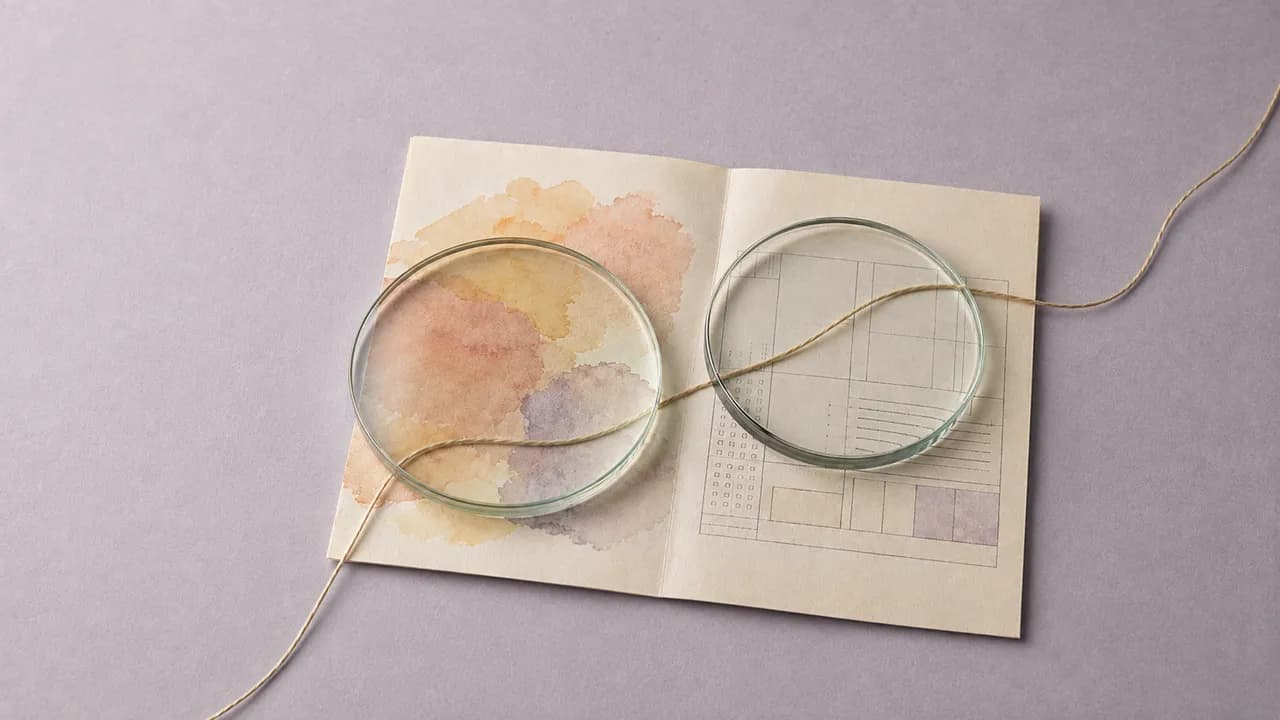
On the large round table of burnished crystal, the proofs of my new paper creature lay alongside the sheets of financial data and the sales charts the publisher had brought. Market projections overlapped the watercolour illustrations: warm images, made to catch the curiosity and the kindly attention of young readers.
I had offered those printed pages with the trembling pride of someone revealing a long-kept secret, hoping to see reflected, in the eyes of the person across from me, the same wonder they had kindled in me. Month after month I had tended every single line of that illustrated volume, weaving a fine thread to whisper to a new generation the deep meaning of courage and of fragility.
To me those pages were invisible threads and necessary landfalls for young souls searching for a course in the dark. To the publishing house, they were also a wager that had to find its own economic balance.
The publisher spread the map of market projections directly over the drawings. With great composure he explained that, at that extent and that rather high cover price, the book would struggle to find its way. To reach the shelves of bookshops it would be necessary to thin the text, tighten the margins and look for a title optimised for search engines.
He closed his reasoning looking me in the eye:
A beautiful dream, not commercially viable.
In that precise instant the air in the room turned suffocating. I felt a knot tighten in my throat before what I perceived as a direct attack on my worth.
My mind threw up an immediate embankment. The crystal table became an invisible border between the care of the spirit and the laws of matter. To defend myself, I reduced the publisher to a two-dimensional profile: the man of numbers, an austere shadow come to sacrifice the delicacy of the text to convenience. I, on the other side, took refuge in the reassuring role of sole champion of the book's ethical honesty.
For a few moments I no longer saw the person in front of me. I felt only the wound those statements had opened.
You are taking the natural breath out of a whole year's work.
I answered, struggling to hold back the bitterness tightening my throat.
If we cut down the central chapter on fragility – the part where the protagonist accepts and welcomes his own weakness and his fear of failing in front of his classmates –, we betray what young readers are waiting for, only to indulge an abstract formula, one of pure market.
He did not reply at once.
At first the emptiness of words wounded me. Then the publisher spoke:
Silvia, tightening the margins and trimming the text does not mean erasing the message. If we keep this cover price, the book will remain a sublime art object, but too expensive for the young people you want to speak to. It will never reach its destination.
The sentence cracked the image I had built.
I could not know, in that moment, whether his proposal was truly the best one. The cut still felt to me like a loss. And yet those statements came from a concrete perspective, bound to his role: to find a balance that would let the work exist in the world and reach the young readers I wanted to address.
Until then, in the numbers I had seen above all what the book would have to lose. Now they also pointed to the possibility that the volume might genuinely reach its readers. The publisher's fingers, running down the costs, no longer looked to me only like an attack on what I felt.
I began to sense that the conflict was showing me not only what I feared losing, but also how far that wound had shaped the way I had listened to what he said.
Immersed though I was in a heavy stillness, I searched for an inner bearing so as not to give in to anger. A lesson of Carl Gustav Jung's came back to me, one I had made my own long before: conflict can become generative, but only if one has the courage to stay calm and remain lucid, looking at one's own soul without filters. To hold the tension, in that moment, did not mean giving up on defending the book; it meant giving up the certainty of being the only one defending it.
The question could no longer be reduced to spirit against matter, to poetry against the market. The value of those pages did not make the economic limits unreal, and those limits did not erase what I feared would be lost.
We went back to the proofs. Together.
We reread the densest passages, slimmed the text, sacrificed part of the pages on weakness to save the essence of the book, and looked for a title able to travel at the right speed in the world as it is.
We had not found a perfect synthesis. Perhaps none exists. But the book had returned to the centre, between us.
Today, looking at the finished project, I feel a concrete ambivalence that still questions me. A shade of regret remains inside me, a sense of loss for that first architecture and primordial purity I had to scale back.
At the same time, I know that in this compromise the work gained a real chance of meeting the eyes of young readers and of inhabiting their silences, brimming with fertile expectation: a chance that does not erase the loss and, in turn, a loss that does not erase that chance.
Perhaps this is what conflict does more often than we are willing to admit: it brings to light what, inside us, is asking to be seen; and yet that same light can leave in shadow the complexity of the person in front of us.
To hold the tension does not mean loving conflict, nor turning every renunciation into a necessary lesson. It means, rather, staying lucid enough inside that unresolved space, and staying there long enough, to recognise what emerges, without hurrying to dissolve the tension with an answer.
I cannot say whether, that afternoon, we had found the best solution. I do know that we were trying, from different perspectives, to bring the same book to the same young readers. For a few moments, the disagreement had hidden what we had in common.
The book came out of that exchange different. The tension stayed on the table, but it no longer filled all the space between him and me.
Did this reading leave something with you?
Continue the path
Before leaving this tension behind, return to the word the path began with, and to the image of something placed before us.
Read «When conflict becomes a threshold»
To learn about her path and the other contributions published in Emozioni, discover Silvia Commodaro.