
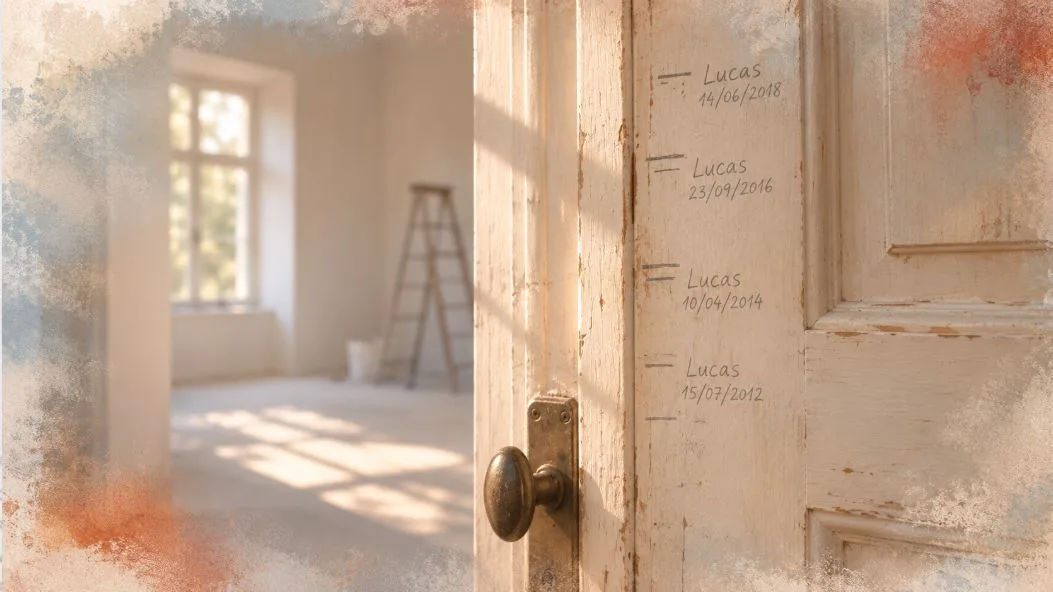
This house is beautiful. It still is, even after the fire, even now that the rooms are empty and the light passes through them with nothing in its way. The fire has damaged its structure, but something of its grace remains: in the shape of the windows, in the proportions of the rooms, in the way daylight enters and lingers.
The new owners have chosen to honour its lines and dress it in white. White walls, white floors, white furnishings. A quiet brightness in which to begin again.
There seems to be no trace of its former life. The furniture has been taken away, the cupboards emptied. Soon, nothing will remain where pictures once hung. The house rests in that brief interval between a farewell and an arrival, when the rooms have stopped recognising footsteps and have yet to learn new ones.
And yet, in the utility room, a door has been left ajar. There, where the boiler and the heating system watch over the warmth of the house, among pipes running along the walls and the low hum of machinery, a narrow strip of darkness seems to hold something time has forgotten.
Far from the main rooms, overlooked at the edges of the renovation, it still looks as it always did. When it is opened, its panels knock against each other: a sharp sound, perhaps familiar to someone, that briefly fills the empty house.
That door, too, must be replaced. It is already almost something to be taken away when someone steps closer and notices a few lines on its surface.
A date. A name. A mark.
Then, a little higher up, the same name, another date.
A few centimetres of life.
You have to stop to read them. Let your eyes follow that little climb, recognise in the handwriting the movement of a hand. And then you can almost see him: a child standing straight with his back against the door, his heels firmly on the floor, his chin slightly raised. Above his head, a pencil. In front of him, someone smiling and telling him to keep still.
For a moment, there is a family in those empty rooms again.
Those lines have kept something no one had thought to put in a box. The years when growing up meant returning to a door and discovering you had reached a little higher. The years when all it took was a pencil to hold on to something that was already passing.
Perhaps those who made the marks no longer remembered them. Perhaps, after living beside them for so long, they had stopped seeing them. They had stayed there, as quietly as everyday things do, while the children really did grow up and life took them far away.
When the former owners are tracked down, they ask only for that piece of the door.
The part with the names and the heights.
Out of an entire house, they want that small section back: narrow enough to take with them, large enough to hold their children's childhood.
The door is carefully taken down. This time, no one is in a hurry. Around it, the work will continue: there will be walls to paint, floors to lay, rooms to live in. But that fragment is set aside, so it can return to those who, without knowing it, had left something there that could never be recreated.
The house will have its new beginning. Other voices, other habits, other footsteps in the hallway. The light will settle on the white and, day by day, that white, too, will become life.
Somewhere else, someone will run their fingers over an old mark and remember how high a child's head once reached. And for an instant, it will feel as though he is still there, right in front of them.
Keep still. Let's see how much you've grown.
Did this reading leave something with you?